Old Car to EV? Government to Offer Rs 50,000 Conversion Incentive (Open Ai)
New Delhi: There is big relief news for the people living in Delhi regarding buying an electric vehicle (EV) or converting their old car into an electric one. Through its new EV Policy 2.0, the Delhi government not only wants to promote new electric vehicles but is also emphasizing removing old polluting vehicles and converting them into clean energy-powered options. The objective of this policy is to reduce the increasing pollution in the capital and to motivate people towards clean energy.
The government has set a target that at least 3 percent of the total vehicles should be converted to electric or retrofitted EVs by the next financial year, 2025-26, starting from April. For this, a complete outline of subsidies and incentives is being prepared.
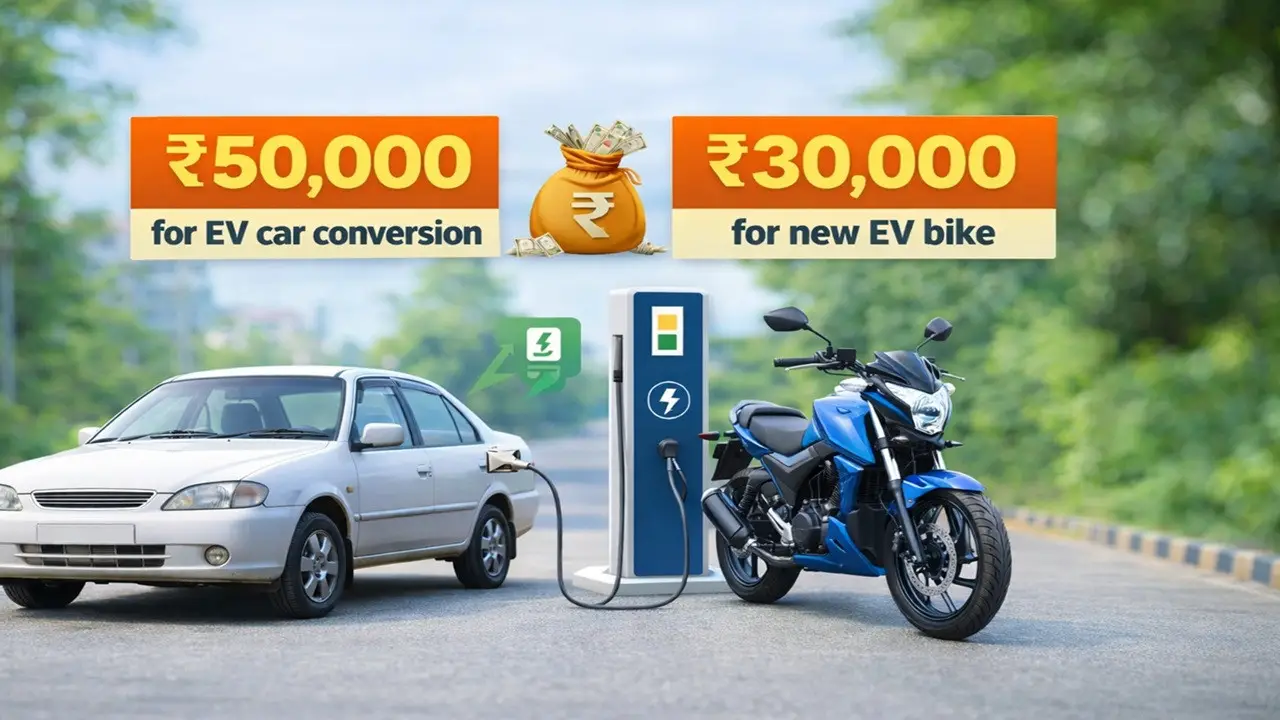
Under EV Policy 2.0, the government is planning to give an incentive of more than Rs 50,000 for retrofitting 10-year-old diesel and 15-year-old petrol cars into electric cars. Generally, the cost of converting any car into electric comes to around Rs 2 to 3 lakh, but with this government assistance, the burden on the pockets of common people will reduce significantly.
It is also proposed in the policy that this incentive will be given for retrofitting the first 1,000 cars. It is believed that this step is for Research and Development (R&D) in retrofitting technology.
Considering the high price of electric cars, the government is also considering giving subsidies on auto loans. According to the proposal, the government can give an interest subsidy of up to 5 percent to those who take a loan to buy an EV.
EV companies had also suggested to the government that if relief is given on loans, the sales of electric vehicles will increase. If this proposal is included in the policy, it will become easier for middle-class families to buy EVs.
The government's focus is especially on providing relief to the middle class. Therefore, a limit on subsidy can be fixed. According to the information, subsidy will be available only on electric cars priced below Rs 25 lakh, the maximum limit of which can be up to Rs 1.5 lakh.
Expensive and luxury electric vehicles can be kept out of this scope because the government believes that people buying such vehicles do not need subsidies. Apart from this, only the first 25,000 cars are likely to be given the benefit of this subsidy.
The Delhi government wants to clean the air of the capital through EV Policy 2.0. Removing old diesel and petrol vehicles and adopting electric options will not only reduce pollution but will also reduce dependence on fuel.
In the coming time, this policy will be reviewed at the level of Chief Minister and Transport Minister, after which it can be formally implemented. If these proposals come to fruition, Delhi will join those states in the country where the most aggressive and people-friendly policy regarding EVs has been implemented.





Copyright © 2026 Top Indian News